Skip to content

For additional press material or interviews, please contact Olivia Stevens.
For information on Olivia’s cabaret shows including audio/video clips, high-resolution photos, and posters, be sure to check out the Repertoire page.

För kompletterande pressmaterial eller intervju vÀnligen kontakta Olivia Stevens.
För mer information om Olivias kabaré och teater förestÀllningar gÄ till repertoarsidan, dÀr finns ocksÄ pressmaterial.

Press Photos

Cabaret-Theater Press

Select a poster to find up to date press material for Olivia’s solo shows.
For a schedule of upcoming appearances, visit the News page.

Stevens…knocked us out with her ferocious performance.

Cabaret Exchange, NY

Stevens…knockade oss med sitt rĂ„a framtrĂ€dande.

Cabaret Exchange, NY

Press Photos

Highest Rating in Cabaret Exchange

…a dazzling performance…brilliance and naked honesty…
The most brilliant

Stevens sings of deep emotions as only the Nordic can.

Time Out, NY

Stevens sjunger om kÀnslor som bara nordbor kan.

Time Out, NY

Press Photos

Stevens sings of deep emotions as only the Nordic

World Class.

Lomma teaterförening

VĂ€rldsklass.

Lomma teaterförening

Press Photos

Reviews

ItÂŽs easy to imagine how our chanteuse lives in the multicultural worlds, the ones that stretch like a bridge over the Atlantic Ocean between Europe

Glamour, despair, decadence and resistance…

Dagens Nyheter, Sweden

Glamour, förtvivlan, dekadens och civilkurage…

Dagens Nyheter, Sweden

Press Photos

Thought provoking…brilliant! Olivia Stevens is a colorful singing actress

Ingrid Strömdal, Svenska Dagbladet

Glittering moments when everything

Tantalizing

Clive Davis, The Times, London

Stevens förför publiken.

Clive Davis, The Times, London

Press Photos

WONDERFUL

Captivating Cabaret about Zarah Leander. It’s funny, intelligent, dramatic and super-professional.

Tony Kaplan, The Swedish Daily, Expressen

Press from Stage Performances

A tour-de force that transcends theater and pulls back the curtain on our lives to reveal familiar memories that haunt us and the hope that we all share.

frenchculture.org

En tour-de force som nÄr bortom teater och drar upp ridÄn för vÄra egna liv, avtÀcker de vÀlkÀnda minnen som jagar

A performance of high professional standards.

Dagens Nyheter, Sweden

Ett framtrÀdande med hög professionalitet.

Dagens Nyheter, Sweden

The most daring expedition of the evening was Olivia Stevens’s performance… she puts on an impressive show.

New York Calling, About Town, NY

KvĂ€llens mest vĂ„gade expedition var Olivia Stevens framtrĂ€dande… imponerande.

New York Calling, About Town, NY

The best New York debut I’ve seen in a long time.

Roy Sander, Backstage, NY

Den bÀsta New York-debut jag sett pÄ lÀnge.

Roy Sander, Backstage, NY

…portrayed with total presence, knowledge and intelligence…

Cabaret Scenes, NY

…gestaltad med total nĂ€rvaro, kunskap och intelligens…

Cabaret Scenes, NY

Stevens, an accomplished singer and film actress in the both Sweden and the United States…leads us with charm and humor…

La Compagnie Trans Atlantique

Stevens, en erkÀnd sÄngerska och skÄdespelerska i USA och Sverige, leder oss med charm och humor.

La Compagnie Trans Atlantique

Stevens – an international performer in her own right, in classical drama, musical theater and television – is a find.

Cabaret Scenes, NY

Stevens – en internationell artist med en gedigen bakgrund inom teater, musikalteater och TV – Ă€r ett fynd.

Cabaret Scenes, NY

Forget Minnelli!

Expressen, Sweden

Glöm Minnelli!

Expressen, Sweden

Sally Bowles is magnificently portrayed by Olivia Stevens. She’s excellent all the way through in both acting and delivery of lines…she is completely radiant when she tells the story of

Stevens’ Anita is convincing in both taunting joy as well as the deepest grief…

Dagens Nyheter, Sweden

Stevens som Anita, övertygar lika starkt i gĂ€ckande glĂ€dje som djupaste sorg…

Dagens Nyheter, Sweden

Stevens’ Anita is convincing in both

…highly professional.

Dagens Nyheter, Sweden

…proffsigt.

Dagens Nyheter, Sweden

Stevens blossoms

Sydsvenska Dagbladet, Sweden

Stevens blommar upp stort

Sydsvenska Dagbladet, Sweden

Olivia Stevens
without uttering a single syllable, renders a magnificent performance


James G Shine, Annandale-on–Hudson Magazine

Olivia Stevens spelar dottern med energi och uppmÀrksamhet

Lars-Olof Franzén, Dagens Nyeter

The Effect of Gamma Rays on Man and Moon in the

Articles & Interviews with Olivia

"'You mustn’t keep money in your mattress. Go out amidst the people and plant them there', Petronella (the actress Olivia Stevens) urges us, in a song that parodies our obsession with money. Fiery scenes where the diva turns into a master of ceremony in a circus, with a whip and German accent lead to still moments where the musician (Miriam Olden burg) makes long sighs with her accordion.

'You must play now', Petronellal shamelessly orders her musician whos sat down by the piano 'I am a Vamp, half beast. I should really be kept in a Zoo. I've picked Himmler's roses and smoke weed in Amsterdam. I bite my men and suck them dry and then I bake them in a pie...'

In a song about a secret club for lesbians in Berlin she reveals a triangle of pink feathers under her skirt. She hungers for freedom and is a rebel of love, singing: 'This is the end of you clipping off our wings'.

Mid show, she puts on a Hitler moustache and purrs: 'There’s something about men with a moustache - I turn into a little pussycat'. After a moustache cavalcade she suddenly grabs a hold of a violin. The moustache ends up on her left shoulder while she proceeds to express her despair over the fact that there are so few real men left in this world. She wants '...a brute who knows how to shoot'. For the first time during the evening, she gives a bit of appreciation to the musician: 'You know, sometimes you're actually quite good. I really mean it.'

No wonder the Cabarets were forbidden by the Nazis.

In January of 1941 the Minister of Propaganda for the Nazis, Joseph Gobbles, wrote: 'Despite my repeated warnings the Cabaret performers continue to mock our unique race. They openly criticize the Political, Cultural and Economic leadership of the Reich. Since my warnings have been in vain, I am forced to take strict measures on behalf of the Fuehrer.'

Plain clothed SS-men were sent to the Cabarets to make sure there was no political critique. The entire ensemble could be called in for questioning and the performers as well as the audience risked being sent to jail or to a concentration camp. But the performers didn't give up; they went underground, changed venues and started up new Cabarets under new names, skillfully hiding their political messages, until they eventually had to escape to survive.'

'Cabaret Verboten' is based on songs written by Jewish composers in Berlin in the 1930s, translated by Monica Hamberg.

Michaela Agoston, Judisk Krönika

"'Du ska inte ha pengar i din madrass. GÄ ut bland folk och plantera dem dÀr', uppmanar Petronella (skÄdespelerskan Olivia Stevens) i en sÄng som gör parodi pÄ fixeringen vid pengar. EldfÀngda scener, dÀr divan förvandlar sig till satanisk cirkusdirektör med smÀllande piska och tysk brytning, bryts av stillsamma ögonblick dÀr musikern (Miriam Oldenburg) lÄter luften pysa i utdragna suckar genom dragspelet.

'Du ska spela nu!', beordrar den hÀmningslöst utspelande Petronella den försynta musikern, som slagit sig ned vid pianot. 'Jag Àr en vamp, jag Àr hÀlften djur. Kanske borde jag visas pÄ Zoo. Jag har plockat Himmlers rosor och rökt pÄ i Amsterdam. Jag tömmer karlarna pÄ allt, jag blandar in dem i min palt...'

I en sÄng om homosexuella kvinnors trÀffpunkt pÄ en hemlig klubb i Berlin blottar hon en triangel an rosa fjÀdrar under kjolen. 'Nu Àr det slut pÄ vingklipperiet', sjunger hon kÀrleksrevolterande och frihetstörstande.

I mitten av programmet kommer hitlermustaschen pĂ„. 'Det Ă€r nĂ„got speciellt med mĂ€n i mustasch, jag blir som en liten kissemiss', jamar Petronella. Sedan följer en mustaschkavalkad, varpĂ„ hon hĂ€ftigt greppar en fiol. Plötsligt hamnar mustaschen pĂ„ vĂ€nster axel och Petronella grĂ„ter ut sin förtvivlan över att bestĂ„ndet av riktiga mĂ€n Ă€r sĂ„ klent. En barbar och en skjutglad karl Ă€r vad hon vill ha. Hon vĂ€nder sig mot musikern, som för första gĂ„ngen fĂ„r litet uppskattning: ”Vet du, du Ă€r faktiskt riktigt duktig, ibland. Jag menar det faktiskt'

Inte undra pÄ att kabaréerna förbjöds av nazisterna.

I januari 1941 skrev Nazitysklands propagandaminister Joseph Goebbels:
'Trots upprepade pĂ„bud fortsĂ€tter kabarĂ©artisterna att hĂ„na vĂ„r unika ras och Ă€ventyrar dĂ€rigenom Rikets enhet. De kritiserar öppet Rikets politiska, kulturella och ekonomiska ledning. DĂ„ mina förmaningar varit förgĂ€ves tvingas jag att vidtaga bestĂ€mda Ă„tgĂ€rder Ă„ FĂŒhrens, vĂ€gnar.'

CivilklÀdda observatörer skickades till kabaréscenerna för att kontrollera att ingen politisk kritik förekom. Hela ensembler kunde kallas till förhör och bÄde artister och publik riskerade att skickas i fÀngelse eller till koncentrationslÀger. Men artisterna gav sig inte, de gick under jorden, bytte lokaler och startade nya kabaréer under andra namn och lindade skickligt in sina budskap tills de slutligen blev tvungna att fly för sina liv.

'Kabaret Verboten' bygger pÄ sÄnger skrivna av judiska kompositörer i 1930- talets Berlin, i översÀttningar av Monica Hamberg."

Michaela Agoston, Judisk Krönika

"Hitler and his ministers even waged a war on the so called decadent cabarets., Besides heckling the power, the cabarets, the songs and the performers represented a moral freedom that had no place in Nazis world order. Musical theatre performer Olivia Stevens and her partner 'KÀte' (Bjarne Löwdin) transport us to 1930s Berlin and one of those basement cabarets threatened to be shut down unless they follow the politically correct protocol. Naturally a cabaret cannot be politically correct since it would cease being a cabaret. The Nazis tried creating their own, with the correct content, but 'not even they wanted to see them', as Stevens says.

This is a show with both humor and seriousity. The humor points are the flamboyant gestures, the Diva role, honored its own special parody where Olivia Stevens takes command fully with the right panache and the dialogue with 'Herman' who's seated in the theatre controlling them. The serious parts are the stories of friends and members of the resistance movement who've either died or fled the country, and the fact that it's only when Herman’s asleep that they can sing and live the way they want to - homosexuality, feminism, strong women, freedom to be who you want to be. And even the analyses, small but often good – like, there's always a little bullied guy behind every swastika badge – a guy who finally gets back at he world. Even though the songs are unknown to me, the style and melodies are well known time markers. It's easy to get into the mood and create from the stage and one experiences clearly how the snare tightens around the neck, how narrow the world becomes when political correctness leads and is driven through by force.

They say the only thing the devil can't stand is someone laughing at him, and dictators are just as thin-skinned. The fact that absolute power doesn't just lack self-criticism but also humor goes back everywhere. That's why we must take care of our satirists. And take to heart that it can happen again that up zany gets world domination. Without anyone really graspin what happened."

Susanne Holmlund, Sundsvalls Tidning

"Och Àven mot de sÄ kallade dekadenta kabaréerna förde Hitler och hans ministrar krig. Förutom att gissla makten stod kabaréerna, sÄngerna och artisterna för en moralisk frihet som inte hade nÄgon plats i nazismens vÀrldsordning. MusikalsÄngerskan Olivia Stevens och hennes kompanjon 'KÀte' (Bjarne Löwdin) tar oss hÀr till 30-talets Berlin och en av de kÀllarkabaréer som hotas med stÀngning om de inte iakttar politisk korrekthet. Och givetvis kan inte en kabaré bli politiskt korrekt, dÄ upphör den ju att vara en kabaré. Nazisterna försökte skapa egna med godkÀnt innehÄll, men 'inte ens de sjÀlva ville se dem', som Olivia Stevens sÀger.

HĂ€r ges vi en förestĂ€llning med bĂ„de humor i allvar. Till humorpunkterna hör de yviga gesterna, divarollen som det görs en liten egen parodi pĂ„ och som Olivia Stevens tar ut svĂ€ngarna i med alla de rĂ€tta manĂ©ren, och dialogen med 'Herman' som sitter i salen och kontrollerar. Till allvaret hör berĂ€ttelserna om de vĂ€nner och motstĂ„ndsmĂ€n som antingen stupat eller lĂ€mnat landet, och faktiskt det faktum att bara nĂ€r Herman sover kan de sjunga om och leva ut det de brukar - homosexualitet, feminism, starka kvinnor, frihet att vara det man sjĂ€lv vill vara. Och Ă€ven analyserna, smĂ„ med ofta goda - som att det kanske finns en liten mobbad kille bakom varje hakkorsbindel - en kille som nu Ă€ntligen fĂ„r ge igen. Även om sĂ„ngerna, i alla fall för mig, Ă€r okĂ€nda Ă€r tongĂ„ngarna och musikstilarna vĂ€lbekanta och pĂ„litliga tidsmarkörer. Det gĂ„r lĂ€tt att kĂ€nna in sig i den stĂ€mning som de bĂ„da pĂ„ scenen vill skapa och man upplever ocksĂ„ tydligt hur snaran knyts Ă„t om halsen, hur trĂ„ng vĂ€rlden blir nĂ€r den politiska korrektheten ska rĂ„da och drivs igenom med maktmedel.

Det sÀgs att det enda djÀvulen inte tÄl Àr att nÄgon skrattar Ät honom, och diktatorer Àr precis lika ömskinnade. Att absolut makt inte bara saknar sjÀlvkritik utan ocksÄ humor gÄr igen överallt. DÀrför ska vi vara rÀdda om vÄra satiriker. Och ta till oss att det kan ske igen att en pajas fÄr vÀrldsherravÀlde. Utan att nÄgon riktigt fattar vad det var som hÀnde."

Susanne Holmlund, Sundsvalls tidning

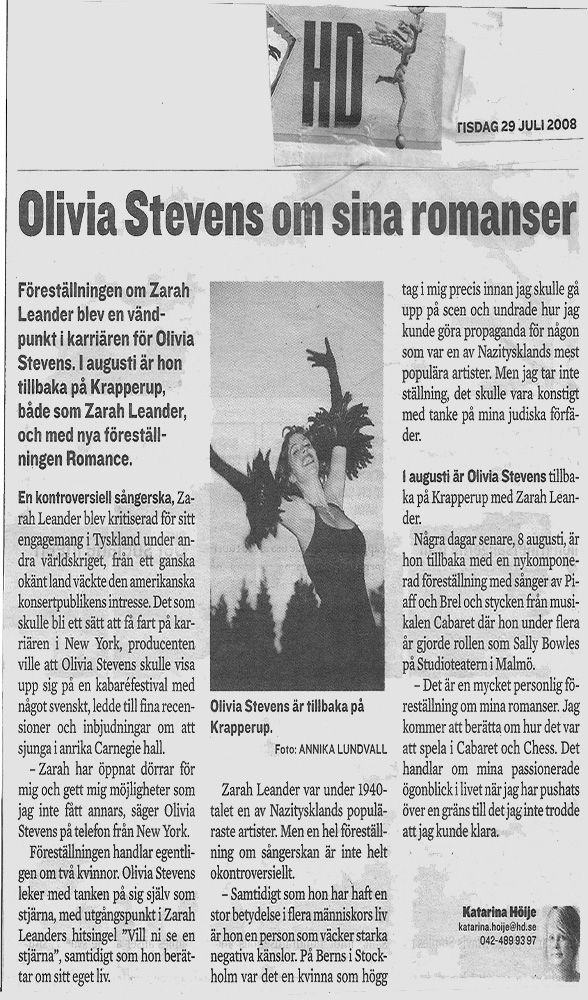
"Genom Ären har man sett massor av musikaliska artistportrÀtt av bland andra Piaf, Marlene Dietrich, Jaques Brel och Zarah Leander. Ingen nÄr den kvalitetstopp som Olivia Stevens demonstrerar.

13 Ă„r efter genombrottet som Sally Bowles i ”Cabaret” i Malmö Ă€r hon tillbaka i SkĂ„ne-metropolen. Och som hon har utvecklats! NĂ€r hon i ord och toner berĂ€ttar om nazisternas idol pĂ„ sĂ„ngens vingar Ă€r det knĂ€pptyst i salongen. Det Ă€r nĂ€mligen en lika fĂ€ngslande som vĂ€lbalanserad och vĂ€lskriven cabaret som Olivia Stevens lĂ„ter rulla upp frĂ„n Victoria-scenen.

Vi bevistade smygpremiĂ€ren igĂ„r kvĂ€ll och kunde konstatera att Stevens inte tar nĂ„gon direkt stĂ€llning för eller emot Zarah Leanders faibless för pengar pĂ„ bekostnad av anseendet och hennes stupida politiska agerande. Det behövs heller inte. Det rĂ€cker med att berĂ€tta som det var för att man naturligtvis skulle kĂ€nna bĂ„de motvilja och avsky. Men vilket pris fick Zarah betala för sin dans med djĂ€vulen, frĂ„gar Olivia Stevens plötsligt och sjunger - fritt översatt - som Die Leander: 'Det kanske var ett misstag – men det var underbart'. Jojo.

"Det Àr intelligent, komiskt, dramatiskt och superproffsigt."
Olivia Stevens visar upp ett imponerande brett register bÄde vad gÀller det vokala och en scennÀrvaro med blÀndande utstrÄlning. Det Àr intelligent, komiskt, dramatiskt och superproffsigt. SÄ vill ni se en stjÀrna Àr det alltsÄ den lilla Victoria-teatern mitt i Malmö som gÀller nu. DÀr fÄr ni en rejÀl dos Berliner-luft av en tjej som Àr helt wunderbar frÄn topp till tÄ.

Tony Kaplan, Expressen

"We've seen many musical portraits of Piaf, Marlene Dietrich, Jacques Brel and Zarah Leander, through the years. No one reaches the top quality that Olivia Stevens delivers.

13 years after the breakthrough as Sally Bowles in Cabaret in Malmö, she's back in the metropolis of SkÄne and she's come a long way! When she through words and songs tells the story of the Nazi idol, you can hear a pin drop in the theatre. It's a captivating, well balanced and well written literary cabaret that Olivia presents from the Victoria-theatre stage.

We saw the sneak preview last night and conclude that Stevens takes no direct stand for or against Sarah Leander's foible for money as well as her stupid political actions. There's no need. It's enough telling the story as it happened for one to feel a strong taste and loathing. What prize did Zarah pay for her dance with the devil, Stevens suddenly asks and sings - freely translated - as Die Leander. 'It may have been a Sin - but it was wonderful'. Well well.

"It's funny. Intelligent, dramatic and super-professional."
Stevens shows an impressively wide range both vocally and through her stage presence with a blinding charisma. It's funny. Intelligent, dramatic and super-professional. So, if you want to see a Star, the little Vctoria – theatre in the heart of Malmö, is the place to go. You'll get a real dose of Berliner–air from a gal who's completely wunderbar from top to toe."

Tony Kaplan, The Swedish Daily, Expressen

"The Manor trollbinds av artistens enorma talang"
"Olivia Stevens...Àr en skÄdespelerska och chanteuse, som med sin energi, nerv, djupa röst och övervÀldigande talang- en kombination av Elizabeth Taylor och Annette Benning- kan frambringa stÄende ovationer. Och det var precis vad hon gjorde, till pianisten David Pearls ackompanjemang, i Le Dome, nattklubben under stjÀrnorna...

Med en tacksam nick mot mÀsterkocken Mitchell Altholtz lÀckerheter...gick vi upp för den svÀngda trappen för att uppleva stjÀrnan pÄ The Manors Cabaret - den ojÀmförliga Stevens frÄn scen, TV och film. Stevens, kunde, som ingen annan artist pÄ The Manor, underhÄlla och matta ut publiken pÄ en och samma gÄng. NÀr hon ÄterfÄtt fattningen, och styrkan igen, ser Manors publik fram emot ytterligare ett framtrÀdande."

Bea Smith, The Independent Press, NJ

"Olivia Stevens, who was born in Stockholm, Sweden, stands alone in her effort to show the world that the unthinkable can be accomplished. She has effectively done so in the presentation of 'Pleasure and Peril – The Story of Zarah Leander', March 23 at The Manor in West Orange.

She is over and above an actress and chanteuse, whose energy and verve, deep-throated voice and overwhelming talent and beauty - a combination of Elizabeth Taylor, from the nose up, and Annette Benning from the nose down - can bring the house down. And that's exactly what she did, with the accompaniment of her pianist David Pearl, up in Le Dome, The Nightclub Under the Stars...with a grateful nod to the delights of Mitchell Altholtz executive chef...we climbed the winding staircase to experience the star of The Manor's cabaret – the inimitable Stevens of stage, television and movies.

This past year, Stevens has been performing her one-woman show, 'Pleasure and Peril', which features the life and songs of Leander, the 'controversial darling of stage and screen in Nazi Germany.' and premiered as part of the Kabarett Fete, which has been awarded a 2008 Back Stage Bistro award for Special Event.

The Bistro Awards will be held April 7 at the Gotham Comedy Club in New York City. She also has traveled to perform the French version at the Avignon Theatre Festival and in Sweden at The Krapperup Castle and as part of the Stockholm Culture Festival. Last November, Stevens performed the show at Carnegie Hall in New York City.

Here at the Manor, she intrigued the audience by beginning her unusual act, with her back to the audience, microphone in hand and adorned in a striking black gown, which she utilized to accentuate the wild events in the life of the Nazis' darling. Then in a deep, sultry, provocative voice and body movement, turned to The Manor audience and she sang 'So, You Want to Be a Star?' in Swedish and English. Her other numbers, dramatically offered in German, Swedish, French and English, which told of the pleasures and grief, often hidden unhappiness, of Leander, stunned the audience into acceptance and submission.

Numbers that ran the gamut of Leander's turbulent life, such as 'It all Began with a Glass of Champagne', 'I Know a Miracle will Happen', 'Wonderland at Night', and 'Never Cry for Love', were compounded in a frenzy of emotions that Stevens utilized to reach her astounded audience. Highlighting the high tensions of the evening were Stevens sensual 'Wunderbar' and 'It isn't the End of the World'. She described Leander's tyranny in a wicked version of 'The Sin was Wonderful', and ending and encore of 'Each time I Hear a Churchbell Ring.'

Stevens, as no other cabaret performer at The Manor could accomplish, entertained and drained the audience, all at the same time.

When she regains her composure, and her ultimate strength in the future, the patrons of The Manor would appreciate another encore performance."

Bea Smith, The Independent Press

"I den skÄnska sommarnatten kÀnns det som om Europa verkligen försöker uppfinna sig sjÀlv pÄ nytt...nÀr Olivia Stevens (en gÄng Sally Bowles i Malmö) pÄ Krapperups borg har svensk urpremiÀr pÄ sin i New York och Avignon prisade Zarah Leander-förestÀllning. Olivia Stevens kraftfulla sÀtt att sjunga Zarah Leanders sÄnger och kÄsera kring den svenska sÄngerskans förvecklingar med nazismen, under portrÀtt av skÄnska upplysningsbaroner, skapar remarkabel efterklang Ät Nobelpristagarnas reflexioner kring den europeiska identiteten.

Precis som Zarah Leander fogligt lÀt sig inpassas i Goebbels manipulationsteorier och bokstavligen blev nÀstan blind av den nazistiska UFA-filmindustrins strÄlkastare (dÀrav solglasögonen), har Sverige lÀnge levt högt pÄ vÀlstÄndsprivilegier och utanförskap - en 'blind flÀck' betrÀffande hÄrda europeiska realiteter.

NĂ€r jag hör Im Wunderland bei Nacht (I Underlandet om natten) pĂ„ en verklig bildningsborg - i det anti-intellektuella och smarta Sverige - slĂ„r det mig att Leanders mörka röst, i Olivia Stevens grandiosa tolkning, förmedlar bĂ„de omoralens förtrĂ€ngning och smĂ€rta. Sverige har dessvĂ€rre inte ens kvar Zarah Leanders kyliga stolthet i förrĂ€deriet - den ironiska kommentaren - utan bara den bortskĂ€mda divans later.

Bristen pÄ intresse för europeiska frÄgor och problem, koncentrationen pÄ vÀlstÄndets spiral av blinda privilegiepositioner och det amerikaniserade levnadssÀttet - allt bidrar till att stÀlla oss utanför den lag och mÀnsklighet som Fuentes, Soyinka och Kertész hÀnvisar till.

En till USA emigrerad sĂ„ngerska sjunger Vill ni se en stjĂ€rna se pĂ„ mig! och Zarah Leander Ă„teruppstĂ„r i sommarnatten som en djĂ€vulsk sinnebild för den svenska benĂ€genheten att för egen vinnings skull bortse frĂ„n 1789 Ă„rs odödliga principer om att alla faktiskt ska vara lika inför lagen.

I sin andra UFA-film Habanera försmÀktar Zarah melodramatiskt i ett olyckligt Àktenskap under Puerto Ricos glödande sol. Hennes befriare uppenbarar sig i gestalt av en svensk lÀkare som ska symbolisera den ariska 'insikten' att nordiska mÀnniskor trivs bÀst med varandra.

Det Àr som om Nobelpristagarna i Berlin och sÄngerskan frÄn Brunnby parafraserar en av Zarah Leanders starkaste filmrepliker. Sommarregnet Àr smÄ, smÄ kalla tÄrar som Ànglarna grÄter för oss."

Ulf Peter Hallberg, KvÀllsposten Expressen

"Olivia Stevens powerful interpretation of Zarah Leanders' songs, and stories of Zarahs' dealings with the Nazis, under the portraits of Barons from the enlightenment, creates a remarkable backdrop to the Nobel prize winners' talks about a European identity.

Just like Zarah Leander docilely allowed herself to be a part of Goebbels' theories of manipulation and almost, literally, became blind by the spotlights of the UFA - filmindustry (hence the sunglasses), Sweden has lived highly from welfare privileges and exclusion fro a long time - a 'blind spot' concerning harsh European realities.

When I listen to Im Wunderland bei Nacht (Wonderland by Night) in a real castle of education - in the anti-intellectual and smart Sweden - I realize that the dark voice of Leander, through Olivia Steven's grandiose interpretation, conveys the displacement and pain of immorality.

But unfortunately, Sweden doesn't even have Zarah Leander's cold, proud betrayal left, only the Divas' spoiled foibles.

The lack of interest in European questions and problems, the concentration on the spiral of prosperity of blind positions of privilege and the American way of life – all contribute to placing us outside of the law and humanity that, Fuentes, Soyinka och KertĂ©sz refer to. Instead, Sweden, for its own gain, looks away from the immortal princliples of 1789, that state that everyone is equal before the law.

In her second UFA - movie, Zarah melodramatically pines away in an unhappy marriage under the sizzling sun in Puerto Rico. Her liberator appears as a Swedish doctor who sympolizes the arian 'insight' that Nordic people prefer one another.

Its as if the Nobel Prize winners in Berlin and the Singer in Brunnby, paraphrase one of Zarah's most poignant lines: The Summer rain is little, tiny cold teardrops that the angels cry for us.

Ulf Peter Hallberg, KvÀllsposten

Hur lÄngt Àr artister villiga att gÄ för att synas och fÄ stÄ i rampljuset? Den frÄgestÀllningen Àr ju inte ointressant idag med tanke pÄ alla mÀrkliga former underhÄllningsprogram dÀr grundidé handlar om att nÄ publikens gunst och röstas kvar för att kunna upptrÀda ytterligare en vecka innan man kanske kastas ut pÄ den mörka soptipp som heter bortglömdhet

Tredje Riket
Ett levnadsöde som kanske bĂ€ttre Ă€n nĂ„got annat illustrerar det tragiska behovet av berömmelse till varje pris Ă€r Karlstadstösen med dopnamnet Sara Stina Hedberg, mer kĂ€nd under artistnamnet Zarah Leander. Hon ko att bli kĂ€nd och delvis upptĂ€ckt mycket genom antinazisten Karl Gerhards försorg, men började under 30-talket att verka Österrike och Tyskland och blev en firad stjĂ€rna och filmskĂ„despelare i det Tredje riket. SjĂ€lv vidhöll hon efterĂ„t att hon alltid varit opolitisk.

Nyanserar
Ur detta liv och Ă€ven denna dikt, har Olivia Stevens satt samman en förestĂ€llning som pĂ„ ett skickligt sĂ€tt varvar de mest kĂ€nda, vibrerande, passionerade och Ă€ven humoristiska sĂ„ngerna och revynumren Zarah Leander framförde, med tillbakablickar pĂ„ hennes liv. HĂ€r fĂ„r divan, med Leanders egna ord, ”primadonna assoluta” berĂ€tta om sitt liv och söka förklara sina möten med Goebbels och Ă€ven Hitler. Men hĂ€r kliver Ă€ven Olivia Stevens sjĂ€lv in i förestĂ€llningen, hon har sjĂ€lv rysk-judiska rötter, och hjĂ€lper till att korrigera de uttalanden som Leander gör och det som Leander sjĂ€lv valde att inte ta upp.

Aningslöshet
PÄ nÄgot sÀtt fÄr man klart för sig att Leander flöt fram i tillvaron, hon kunde i sin sjÀlvbiografi ge exempel pÄ en total aningslöshet nÀr det gÀllde den politiska makten: hon föreslog Hitler vid en bordskonversation att han borde byta frisyr och undrade om propagandaminister Goebbels uppskattade att engelsmÀnnen kallade honom en Machiavelli. Kanske var denna aningslöshet en tacksam mask att hÄlla fram i efterhand. Utan att moralisera för mycket gestalter Olivia Stevens alla de motsÀgelser Leanders liv utgör och gör samtidigt hennes val och moraliska tveksamheter till allmÀngiltiga frÄgestÀllningar. Hur lÄngt Àr vi sjÀlva beredda att gÄ för att söka bekrÀftelse? Vad hade vi sjÀlva gjort i hennes stÀlle? Vad nazismen stÄr för behöver hon knappast nÀmna, det rÀcker med det rÀcker med upprÀknandet av namnen Auschwitz och Bergen Belsen.

Passande metafor
Dessutom Ă€r Olivia Stevens och begĂ„vad sĂ„ngerska med en kĂ€nsla för Zarah Leanders vibration och typiska gester - och inte helt olik. NĂ€r hon kliver upp pĂ„ scenen kĂ€nns det som att hon kommer frĂ„n en annan tid. Zarah Leander sjĂ€lv blev nĂ€stan blind av att stĂ„ i rampljuset. Som Stevens konstaterar Ă€r ju det en passande metafor för en blindhet av annan sort som stjĂ€rnan visade upp.

Olivia gör en övertygande diva tolkning av Zarah Leander, med stark röst, mimik och Àven gester. Solglasögonen tvingade divan bÀra efter för mycket tid i rampljuset."

Valdemar Lönneroth, VÀnersborgaren

Starka franska kÀnslor
"Den franska visan, chansonen, Àr inte sÄ ofta hörd idag, inte vÄra delar av vÀrlden iallafall. Men vi som upplevt mitten av 1900- talet har hört den. Och ofta för den oss tillbaka till en tid dÄ Europa var nÄgot annat Àn i dag, mindre prÀglat av medier, affÀrsmÀssighet och globalisering. Till en tid nÀr fransk musik var mer olik andra europeiska lÀnders kultur. NÀr sÄngerna liksom steg ur folkdjupet, frÄn gatorna, krogarna och rÀnnstenarna och verkligen bar pÄ ett budskap om det franska kynnet. Och nÀr sÄngernas och valsernas vemod, snabba och ibland oregelbundna rytm och tonsprÄket som tvÀrt vÀxlar mellan moll och dur bÀr pÄ mycket sorg men ocksÄ stor glÀdje. Fransk sÄng Àr kÀnslor, och störst av allt i kÀrleken - för mÄnga Àr den franska kulturen kÀrlekens.

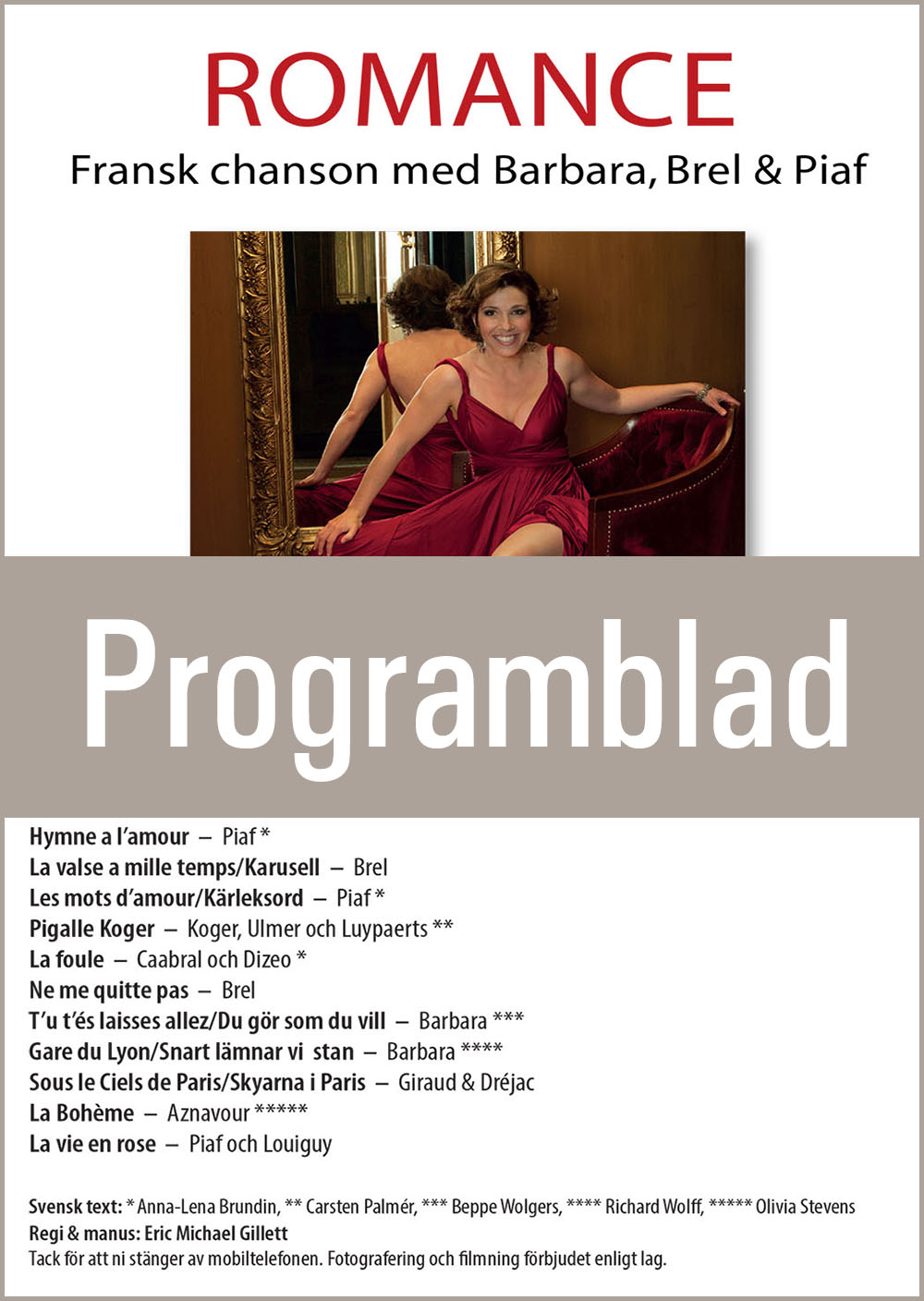
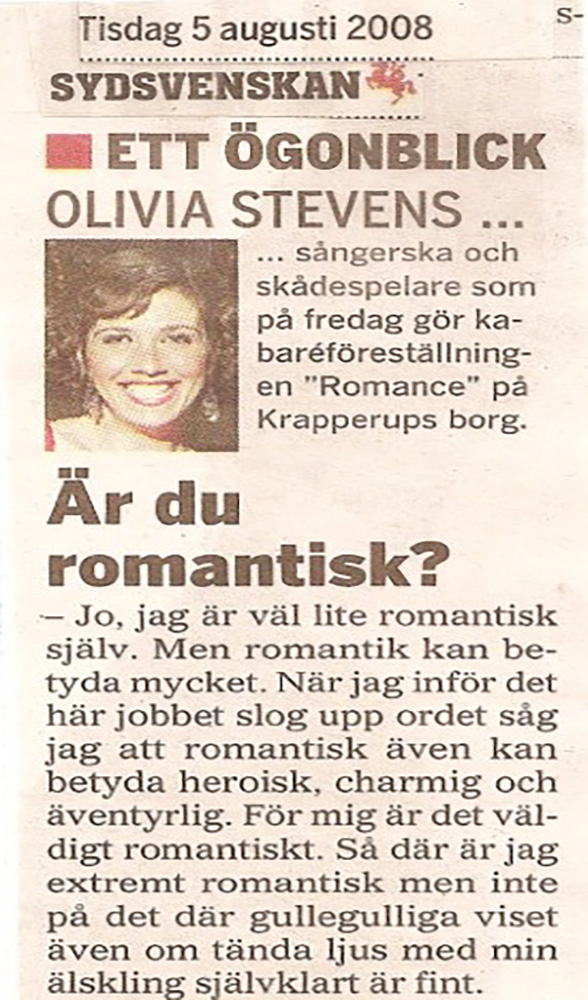
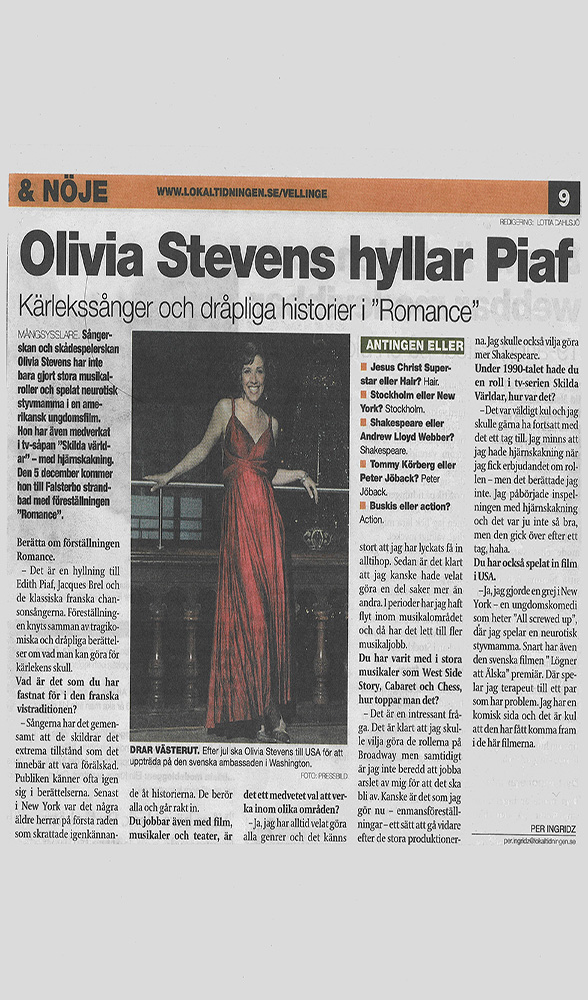
'Romance' - programmet - uppfört i Sundsvall pÄ Alla hjÀrtans dag - har kÀrleken som löst tema med Àr frÀmst en hyllning till artister som Edith Piaf, Jacques Brel och Charles Aznavour. Olivia Stevens Àr ingen Piaf - kopia och försöker inte heller vara en.

Hennes röst Àr mörk, klangrik i vissa register och för kvÀllen nÄgot ojÀmn och beslöjad, vilket dock kunde ha att göra med förkylning, sades det i foajén. Men hon gestaltar fullt ut, hennes dramatik och utspel Àr sÄ stort som denna in- och utlevelsens kultur krÀver.

Tillsammans med utmÀrkta pianisten Bjarne Löwdin bÀr hon upp fraserna, tÀnjer tempot och frigör sig. Det kan vara mycket omsorgsfulla, mjuka och viskande - som i 'La valse a mille temps', som inleds försiktigt och sedan ökar som den karusell sÄngen handlar om, och de kan leverera en fransk vals snabbt, smidigt och medryckande.

De har en bestÀmd uppfattning om vad de vill skildra med varje sÄng och dÀrmed blir ocksÄ sÄngerna smÄ sammanhÄllna teaterstycken, smÄ romaner.

Visst Ă€r det bra att vissa sĂ„nger sjungs pĂ„ svenska, i alla fall de mer innehĂ„llsrika texterna, men för att fĂ„ sin rĂ€tta identitet ska chansonen förstĂ„s sjungas pĂ„ franska, i 'La vie en rose' tolkar Olivia Stevens vĂ€ldigt Piaf-likt och sĂ„ ska det nog vara, sĂ„ prĂ€glad som den Ă€r av henne. Chansonens frĂ€msta röst – nĂ€st den mĂ€nskliga – Ă€r dragspelet och Bjarne Löwdins spel har den flytande energin och flödet som fĂ„r kroppen att följa med i vĂ€lkĂ€nda valsen 'Pigalle' och ger honom extra applĂ„der nĂ€r han tar upp 'Under Paris himmel' som blivit stadens signatur.

De smÄ sketcherna och anekdoterna mellan sÄngerna behandlar inte kÀrleken som nÄgot ömtÄligt och sorgligt, de Àr tvÀrtom ganska drÄpliga - kanske för att sÀkra att programmet inte blir för dystert. Men det ingen risk. Den hÀr musiken Àr iallafall för mig mer en epok Àn nÄgot annat; en stÀmning som ibland för lyssnaren till de glada barerna dÀr vinet flödar och alla sjunger dansar, till den stora svÀrtan och förlamningen nÀr kÀrleken inte höll vad den lovade.

Till de starka kÀnslor i alla riktningar som för mÄnga av oss Àr Frankrike och frÀmst dÄ Paris, i en tid dÄ konstnÀrskvarteren Ànnu inte hade gett vika för kontorskomplex."

Susanne Holmlund, Sundsvalls tidning

"The French chanson isn't heard that often, at least not in our part of the world, but those of us who've experienced the mid 1900s, have heard it. It often brings us back to a time when Europe was still something else, with medialized, less businesswise, less globalized. To a time when French music was different from other European countries. When the songs rose from the depths of the streets, the bars and the gutters and carried a message of the French soul. When the melancholy songs and waltzes, their quick and sometimes irregular rhythm and tone, switching between major and minor, carried so much sorrow and joy. French song is emotions and the greatest of them all is love. To many people, French culture is the culture of love.

'Romance' performed on Valentine's Day has love as a loose theme but is foremost a celebration of artists like Piaf, Brel and Aznavour. Stevens isnÂŽt A Piaf copy and doesn't try to be one either.

Her voice is deep and rich. She performs fully with the drama and intensity that this culture of expression demands. Together with excellent pianist Bjarne Löwdin, she carries the phrases, stretches the tempo and frees herself from it. Like in the very soft, whispering beginning of 'La Valse a Mille Temps' that carefully escalates like the carousel in the song. They know how to deliver a quick, smooth and captivating waltz.

They know what they want to convey with each song, so the songs become little, contained theater pieces, little novels. It's good that the songs are sung in Swedish, at least the ones with the richest lyrics, but in order to get their identity they should be sung in French. Olivia Stevens interprets 'La Vie en Rose' in a very Piaf-like way, and that's how it should be. The greatest voice of chanson, next to the human, is the accordion and Bjarne Löwdin has the flowing energy that makes your body sway to the wellknown waltz 'Pigalle' and gives him extra applause when he takes up 'Under Paris skies' the city's signature song.

The little sketches and anecdotes between the songs do not treat love as something fragile and sad, as a contrast they're pretty hilarious - perhaps to ensure that the program doesn't become too somber. But there's no risk of that. This music is, at least for me, more of an era than anything else; an ambiance that sometimes brings the listener to the happy bars where the wine flows and everybody's singing and dancing, to the great darkness and paralysis when love didn't keep its promises.

They transport us to the strong emotions in all directions, that many of us associate with France and especially Paris, in a time when the artist quarters still hadn't given way for office buildings."

Susanne Holmlund, Sundsvall's Paper

"A short time ago Olivia Stevens, the Swedish-American actress singer, did a cabaret show entitled Pleasure and Peril about Zarah Leander as part of Karen Kohler's award-winning series Kabarett Kollektif. Leander, was the Swedish singing actress who became the biggest movie star in Nazi Germany when Dietrich refused Hitler. Stevens' show was a stunning, informative performance and Stevens has performed the show many times here and abroad.This year Stevens has returned in a new show entitled Passion at the Metropolitan Room. This time, under the skillful direction of Eric Michael Gillett, and with great musical support by Erich Rausch on piano, Stevens is taking the scapel to her own life story which she calls 'an artist's journey into the light.' Passion gives her full scope to demonstrate her accomplished singing and acting in a wide variety of song styles in several languages.

  Entering in a chic black outfit, Stevens launches into 'The Singer' by Kander and Ebb, breaking up the lyrics by telling us bits of her life story. Without pause, she begins describing an audition for the famous stage writer-director Ariane Mnouchkine of the Theatre de Soleil in Paris. Standing at the top of a tall ladder, she is terrified when Mnouchkine tells her to fall backwards. Singing 'Look Mommy, No Hands' Stevens draws us into her world of memories. Flashing back to being late for her first rehearsal as Sally Bowles in Stockholm and falling in love with the actor playing Cliff... She gives us her dazzling performance as Sally, tearing defiantly into 'Don’t Tell Mama,' and plaintively singing 'Maybe This Time...' But she discovers the actor she loves is gay and her response is a proud, angry 'Mein Herr,' sung in Swedish.

  Announcing individual titles to sections of her show, 'A Tale of Obsession' describes the vegetarian she gets involved with. She dramatically sings in French and English Edith Piaf's great 'Hymne a L'Amour (If You Love Me, Really Love Me)' in a big theatrical voice, a startling showcase for her classically trained soprano.

  'The Story of the Big Break' has Stevens discussing her frantic auditions for the part of Anita in West Side Story in Stockholm. The choreographer doesn't think she can dance the part and she is dismissed from the auditions. She tries out again and for weeks she doesn't hear from the director. When the cast is finally announced there is no one announced for the part of Anita. The director tells her the choreographer still doesn't want her but he wants her if she will promise to rehearse her dance numbers every day with the choreographer who despises her. She does and she goes on to a major triumph in the role. We get the splendid sampling of that award winning performance by Stevens singing 'A Boy Like That' and 'I Have A Love.'

  By candlelight in French she sings with quiet intensity Jacques Brel's 'Ne Me Quitte Pas.' Taking a strong political and feminist stance, Stevens performs intensely a speech from Antigone, another of her stage roles. She sings a raunchy rare Frederich Hollander song 'Chuck Out The Men'. She mourns 'The Man That Got Away,' phrasing it differently than Garland and making it her own. Making pacts with love again and again, she pushes us to the edge of despair with Leonard Cohen's 'Dance Me To The End of Love'. We have participated in the full spectrum of Stevens' brilliance and naked honesty.

  This brings us back to Stevens on that ladder, now fearlessly falling backwards into the light. Stevens reprises 'Look Ma, No Hands,' realizing that every moment and every love of her life was one of passion and she has the strength to be proud of it and go on. The most brilliant coup de theatre is Stevens' penultimate rendition of Brel's 'Valse of Mille Temps (Karusel)' sung in Swedish. The song known in English as 'Carousel' begins slowly and each refrain suddenly becomes faster and faster and faster. Stevens knocked us out with her ferocious performance, never missing a note and communicating to us with her skill at the tongue-twisting lyrics, even in Swedish!!

  For her encore, in a totally different mood and yet another lyrically different voice, Stevens sang sweetly a Zarah Leander song, the charming 'Church Bells.'"

Joe Regan Jr., Cabaret Exchange, NY

"Den svensk- amerikanska skÄdespelerskan och sÄngerskan Olivia Stevens spelade nyligen sin ZARAH LEANDER kabaré, i Karen Kohlers prisbelönta Kabarett Fete. Leander, var en svensk, sjungande skÄdespelerska som blev den största stjÀrnan i Nazi Tyskland, nÀr Dietrich nobbade Hitler. Stevens förestÀllning var enastÄende och har sedan dess spelats mycket bÄde hÀr och utomlands.

Nu Ă€r Olivia tillbaka med sin nya förestĂ€llning, PASSION, som spelas pĂ„ the Metropolitan Room. Även den hĂ€r gĂ„ngen har regissören, Eric Michael Gillett bidragit med skarp regi och pianisten Erich Rausch stĂ„r bakom det starka musikaliska stödet. I 'Passion - En artists resa in i ljuset' utforskar Stevens sin egen livshistoria, och hennes mĂ€sterliga sĂ„ng och skĂ„despeleri fĂ„r fritt spelrum i varierade sĂ„ngstilar, pĂ„ flera sprĂ„k.

Hon gör entré i en chic, svart kostym till Kander & Ebbs 'The Singer', och bryter ibland av sÄngen med en berÀttelse ur sitt liv. Hon forstÀtter direkt med att beskriva en audition för den berömda teaterregissören och författaren Ariane Mnouchkine, pÄ Théùtre du Soleil i Paris. Olivia stÄr högst upp pÄ en stege, och blir skrÀckslagen nÀr Mnouchkine ber henne att falla baklÀnges. Med sÄngen 'Look Mommy, No Hands', för Stevens oss in i sin vÀrld av minnen. En flashback till nÀr hon kom för sent till den första repetitionen av CABARET dÀr hon spelade Sally Bowles, och sedan blev förÀlskad i skÄdespelaren som spelade Cliff. Hon ger oss en blÀndande uppvisning som Sally, i en trotsig 'Don't Tell Mama', och en trÄnande 'Maybe This Time.' NÀr hon upptÀcker att skÄdespelaren Àr homosexuell svarar hon med en stolt och bitande 'Mein Herr,' pÄ Svenska.

FörestÀllningens olika delar presenteras med rubriker, och 'BerÀttelsen om Besattheten' handlar om vegetarianen hon blir ihop med. Piafs, 'Hymne a L'Amour' sjunger hon med stor, teatral röst, - och den blir en blÀndande 'showcase' för hennes klassiskt trÀnade sopran. I 'BerÀttelsen om den stora Chansen' deltar Stevens i en vansinnig audition för rollen som Anita in West Side Story i Stockholm. Koreografen tycker inte hon dansar tillrÀckligt bra och hon fÄr lÀmna audition. Hon prövar igen och nÀr rollbesÀttningen utannonseras Àr rollen som Anita Ànnu inte tillsatt. Regissören sÀger att hon fÄr rollen om hon lovar att dansa varje dag med koreografen, som avskyr henne. Hon gör det och firar triumfer. Vi fÄr ett smakprov pÄ rollen som blev hennes genombrott i, 'En sÄn som han' och 'KÀrlek Àr Allt'.

Olivia sjunger Jacques Brels 'Ne Me Quitte Pas' med lÄgmÀld intensitet och ett tÀnt ljus som belysning. En politisk och feministisk del ur Antigone leder in i den frÀcka Friedrich Hollaender sÄngen 'Ut med alla karlarna', och Olivias helt egna version av Judy Garlands 'The Man That Got Away'. Hon ingÄr en pakt med kÀrleken om och om igen och för oss hela vÀgen till besvikelsens brant med Leonard Cohen's 'Dance Me To The End of Love'. Vi fÄr ta del av hela spektrat av Stevens brillians och nakna Àrlighet.

BerÀttelsen tar oss tillbaka till ögonblicket nÀr Stevens sitter högst upp pÄ stegen, och nu faller hon orÀdd baklÀnges in i ljuset. I reprisen av 'Look Mommy, No Hands' inser hon att varje ögonblick och kÀrlek, var ett ett ögonblick av passion, och att hon nu har styrkan att vara stolt över det, och gÄ vidare.

Det mest briljanta ögonblicket i förestÀllningen Àr, den nÀst sista sÄngen: Brels 'La Valse a Mille Temps (Karusell)' pÄ Svenska. Den börjar lÄngsamt och tempot ökar gradvis för varje vers. Stevens knockade oss med sitt glödande framtrÀdande. Utan att missa en enda ton förmedlade hon skickligt sÄngens budskap, trots att hon sjöng pÄ Svenska!!

I extranumret skapade Stevens en helt annan stÀmning och röstklang, med den charmanta Leander- sÄngen 'Church Bells.'"

Joe Regan Jr, Cabaret Exchange

"SuccéunderhÄllning för finsmakare."
"Den mÄngsidiga artisten Olivia Stevens har ÄtervÀnt till Malmö. Efter sin prisade Zarah Leander-förestÀllning Àr hon nu hÀr med en sjÀlvutlÀmnande underhÄllning för finsmakare - 'Passion'. Det Àr en vÀlskriven solouppvisning fylld av komik - med mÄnga tragiska förtecken.

Den handlar om den unga Bette Midler-imitatören Olivia Stevens, som ville bli nÄgot. Den handlar om en orolig sjÀl i en orolig vÀrld - showbusiness. Den handlar om hur hon blir förÀlskad i sin motspelare i Malmö - som visar sig vara gay.

Den handlar om audition-livets helvete. Om drömmar och om ensamhet i ett myller av genier, drogmissbrukare, vegetarianer och krÀvande mÀnniskor. Om en vÀrld dÀr alla trampar pÄ alla. Den handlar om den vÀrld Olivia Stevens vistats i pÄ jakt efter harmoni. Om hur hon pÄ sin 30-Ärsdag hade tre jobb och en hjÀrnskakning samtidigt som hennes pappa lÄg döende i cancer. - Allt jag hade var mig

Olivia Stevens bjuder frikostigt pÄ sig sjÀlv i en kvalitetsmÀttad förestÀllning. Denna lika förtrollande som fascinerande berÀttelse om livets baksidor kantas av tongÄngar signerade bland andra Fred Ebb och John Kander, Kurt Weill, Bernstein, Gershwin, Leonard Cohen och Björn Ä Benny. Punkten sÀtts med Jacques Brels 'Karusell' - och livet virvlar vidare.

PremiÀrpubliken i gÄr kvÀll tackade med mycket lÄnga och mycket varma applÄder. Olivia Stevens, och hennes pianist Bosse Johansson, förtjÀnade varenda en. Succérepris pÄ Victoria i Malmö i kvÀll."

Tony Kaplan, Expressen

"The versatile performer, Olivia Stevens has returned to Malmo. After her celebrated Zarah Leander- show she’s back with revealing entertainment for gourmets - 'Passion'. It’s a well-written solo extravaganza filled with comedy – set against a tragic backdrop.

It's about the young Bette Midler imitator Olivia Stevens who wanted to be somebody. It's about restless soul in a restless world-showbiz. It's about how she falls in love with her co-actor in Malmo – who turns out to be gay.

It's about the hell of auditioning. About dreams and loneliness in the midst of genius, drug addicts, vegetarian's and demanding people. About a world where everyone steps on everyone. It's about the world Olivia Stevens has resided in in the search for harmony. About how she on her 30th birthday had three jobs and a concussion while her father was dying of cancer. - All I had was me.

Olivia Stevens shares her story generously in a show high quality show. This enchanting as well as fascinating story about that dark side of life is filled with songs by Fred Ebb and John Kander, Kurt Weill, Bernstein, Gershwin and Leonhard Cohen among others. It nails the ending Jacques Brel's 'Carousel' - and life twirls on.

Last night's opening night audience gave thanks with very long and very warm applauds. Stevens, and her pianist Bosse Johansson, deserved every one of them. Success encore Victoria in Malmo tonight."

Tony Kaplan, Swedish EXPRESSEN

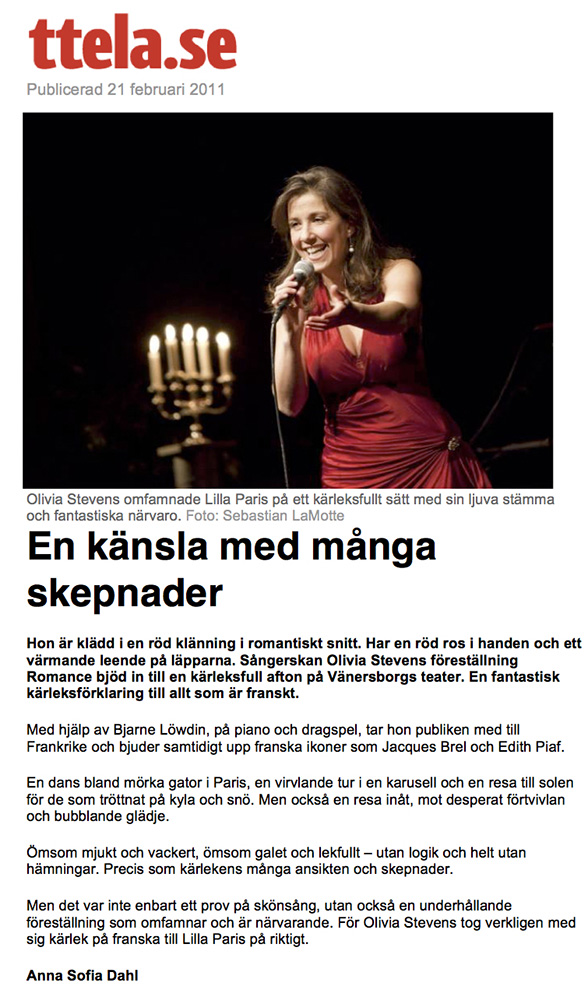
"Precis som titeln pÄ hennes förestÀllning pÄ the Metropolitan Room, Olivia - Passion, Àr Olivia Stevens passion sÄ fort hon gÄr in pÄ scenen. Hon bjuder in alla kÀnslor sÄngerna har att erbjuda, och biter njutningslystet in i dem.

Hon Àr skÄdespelerska. Hennes starka och mÄngfasetterade röst tar henne frÄn berusande mörka toner till mjukare och högre höjder. Men i den hÀr förestÀllningen, som följer hennes karriÀr och romanser Àr det skÄdespelartalangen, energin och dans trÀningen som driver gestaltandet framÄt med dramatik och grace.

Stevens har en robust röst och Àr extra spÀnnande i de mjukare partierna: uppslukad av livsfrÄgor i 'Where I Want to Be' (Chess) av Andersson/Ulvaeus och Tim Rice. Och i den trÀffsÀkra tomheten i 'Look Mommy, No Hands' (Keane). Regissören Eric Michael Gillett har gjort refrÀngen: 'Vad obetÀnksam man Àr nÀr man Àr ung...' till navet som förestÀllningen kretsar runt.

Jag tyckte om Stevens spÀnnande franska och tyska tolkningar med deras blandning av sentimentalitet och cynism, och jag fick jag en kick av att höra 'Cabaret' pÄ Svenska. Stevens ackompanjerades av pianisten Eric Rausch."

Elizabeth Ahlfors, Cabaret Scenes

"Like the title of her show at the Metropolitan Room, Olivia – Passion, Olivia Stevens is passion from the moment she walks on stage, inviting all emotions the songs offer, and sinking into them with relish.

She is an actress. Her voice is strong and versatile, taking her into intoxicating low tones and gentle higher territory. It is her acting talent, however, and her energy and dance training that drive her performance with drama and grace.

While she has a robust belt, Stevens was most compelling in her softer numbers, consumed by life's questions in 'Where I Want to Be' (Chess) by Andersson/Ulvaeus and Tim Rice, and the poignancy and emptiness in 'Look Mommy, No Hands' (Keane). Director Eric Michael Gillett wrapped the show around the song's point, 'How careless we are when we're young.'

There are some cabaret fans who do not appreciate songs in other languages. I am not one of them; I enjoyed Stevens' compelling French and German renditions, with their mix of sentimentality and cynicism, and I got a personal kick out of hearing 'Cabaret' in Swedish. Stevens was accompanied by pianist Eric Rausch."

Elizabeth Ahlfors, Cabaret Scenes

"It was quite an evening when Swedish-American artist Olivia Stevens performed her program "Passion," with Erich Rauch playing the piano, at the House of Sweden in Washington last night, Friday, February 25. She delivered a rich mixture of songs and stories from her Swedish, French, Norwegian and American experiences, with lyrics and narratives in Swedish, English, French and German.

For the occasion, the House of Sweden transformed its Alfred Nobel Hall into a cabaret night club for the performance, complete with cocktail tables with candles, low lights and plenty of wine for the audience.

Ms. Stevens was born in Sweden to an American father and a Swedish mother, and is now based in New York and Stockholm. She has starred in plays and musicals in London, Stockholm, Oslo and Warsaw. Being a true cosmopolitan, she has performed at the Théùtre du Soleil in Paris, played Shakespeare In London and Oscar Wilde in New York. Critics hailed her leading roles in Cabaret, West Side Story and Chess as "outstanding."

This year, Olivia Stevens has performed her acclaimed one-woman shows "Pleasure & Peril" and "Romance" to sold-out audiences in Europe and New York City. She has also co-starred in the feature film "All Screwed Up," and her Swedish feature film "Lies to Love" opens in Europe this spring."

Swedish Scene, Washington DC

"Forbidden Cabaret"
"We're in Berlin in the 40s. A shady basement locale is the stage of the remaining exile cabaret Katakombe. Gobbles has declared war against the city's cabarets that, according to him, have mocked the superior race and made fun of the political leaders. The majority of the ensemble has already been deported and the audience is informed that Judith's balance act, that everyone has come to see, no longer is on the repertory since Judith's been taken away by the Gestapo.

Left on stage is Petronella, the star of Kabaret Katakomb (Olivia Stevens) and her accordionist (Maria Peters). The balance act between trying to satisfy the officers in the audience while following ones own conviction becomes increasingly desperate. The consequences are fatal when Petronella decides to stop compromising.

Lacrimosa's stage Gavelius is transformed to its advantage, into an intimate cabaret stage; the audience seated around little cafe tables in the cafe. Jewish composers in the 20-ies wrote the songs. Giddy and entertaining on the surface, but beneath the ironic lyrics hide provocative, political messages about corruption and a struggle for free love.

Steven's voice goes straight through your skin. She nuances between defying self-confidence and fragility in both singing and acting and her stage presence makes you catch yourself, more or less holding your breath throughout the entire show. It's as if the audience has a knife against its throat - The interaction with imaginary officers, the German accent and the nervous, meaning gazes to the accordionist Kathe, add an extra nerve to the drama. The repertory fluctuates between savvy, funny numbers and serious songs. During the last, trembling minute of the show the performers summon their courage to perform a final piece: a Partisan song in Yiddish that takes your breath away.

Cabaret Verboten is not only a fantastic experience musically but a beautifully seamless show about life on the brink of death."

Therésia Erneborg, TeaterStockholm.se

"Vi befinner oss i 40 - talets Berlin. En skum kÀllarlokal agerar scen för den lilla kvarvarande skaran i exilkabarén Katakomb. Goebbels har förklarat krig mot stadens kabaréer som, enligt honom, lÀnge nog drivit med makten och hÄnat den överlÀgsna rasen. Större delen av ensemblen har redan deporterats och publiken meddelas att Judits balansakt, som sÄ mÄnga kommit för att se, inte lÀngre stÄr pÄ repertoaren, eftersom Judit blivit hÀmtad av Gestapo. Kvar pÄ scenen finns Kabaré Katakombs stjÀrna Petronella (Olivia Stevens) och hennes dragspelare (Maria Peters). Det blir en alltmer desperat balansakt att försöka tillfredsstÀlla publikens officerare och samtidigt följa sin övertygelse. NÀr Petronella bestÀmmer sig för att sluta kompromissa fÄr det ödesdigra konsekvenser.

Lacrimosas Scen Gavelius har med fördel förvandlats till en liten intim kabaréscen dÀr publiken sitter utplacerade kring mindre bord i caféet. Musiken hÀmtar inspiration frÄn sÄnger av judiska kompositörer frÄn 20 talet. PÄ ytan Àr den glÀttig och underhÄllande, men de ironiska texterna döljer ett provocerande politiskt budskap om maktmissbruk, fri kÀrlek och kamp.

Stevens röst gÄr rakt igenom huden. Hon nyanserar mellan trotsig sjÀlvsÀkerhet och kÀnslig sprödhet i bÄde sÄng och utspel och hennes scennÀrvaro gör att man kommer pÄ sig sjÀlv med att mer eller mindre hÄlla andan genom hela förestÀllningen. Det Àr som om hela publiken har kniven mot strupen. Interaktionen med imaginÀra officerare, den tyska accenten och de darrande, menande blickarna till dragspelerskan KÀthe ger ytterligare nerv Ät dramat. Repertoaren vÀxlar mellan frÀcka, humoristiska nummer och allvarligare, sorgliga sÄnger. I förestÀllningens sista, skÀlvande minut samlar artisterna mod och framför Judits sÄng. En partisanvisa pÄ jiddisch som gör att det knyter sig i bröstet.

Kabaret Verboten Àr inte bara en musikaliskt sett fantastisk upplevelse. Det Àr en helgjuten förestÀllning om liv precis pÄ grÀnsen till död."

Therésia Erneborg, TeaterStockholm.se